



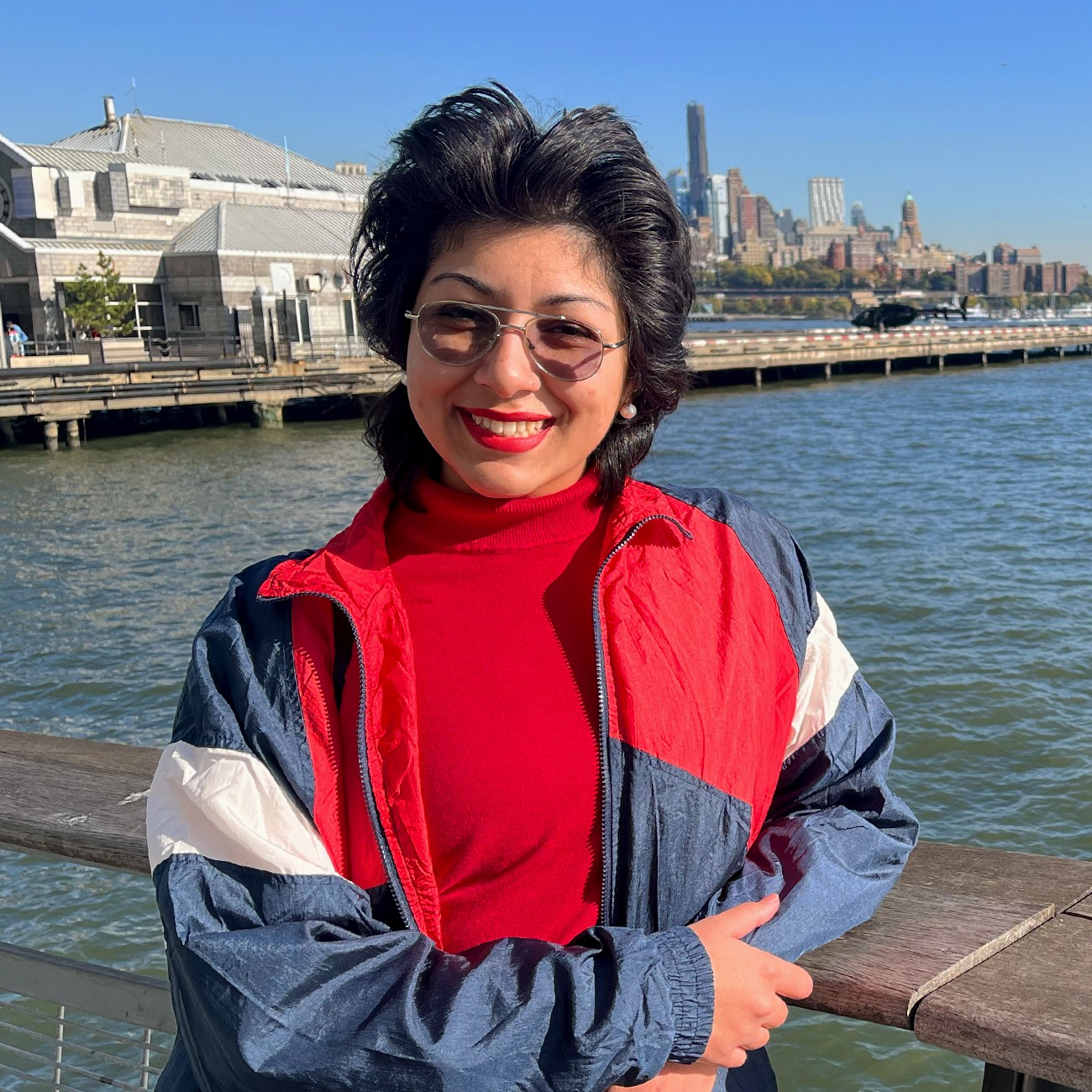
Today we’d like to introduce you to MiMi B..
Hi MiMi, thanks for joining us today. We’d love for you to start by introducing yourself.
I grew up in a newspaper family with my mother working as a reporter, so I was exposed to storytelling and visual communication early on. That foundation led me to pursue design professionally, and now I work as a multimedia designer based in Baltimore. I’ve had the privilege of creating everything from motion graphics to art direction for clients ranging from Google and Sony Music to small businesses and nonprofits like The Realm Co. and CASA of Cecil County (basically, if it needs to look good and mean something, I’m your person). As a certified art coach, I help creatives find their visual voice, which naturally led to speaking opportunities like AIGA Baltimore and Johns Hopkins University. I’ve also got some exciting workshop collaborations coming up this summer, but those are still under wraps. My approach is collaborative and community-oriented, though I’ll admit I bring more enthusiasm to the table than I probably should at 9am strategy meetings.
Alright, so let’s dig a little deeper into the story – has it been an easy path overall and if not, what were the challenges you’ve had to overcome?
Not even close to smooth. Growing up Thai and Italian gave me a bicultural perspective that doesn’t fit neatly into the boxes people expect in creative spaces, and that’s created friction in unexpected ways. I’ve been screamed at by clients over poster revisions, treated like an assistant fetching cigarettes and coffee when I was literally hired as the designer, and had my work extracted and undervalued by aspiring rappers and small businesses who gaslit me into giving more than I was being compensated for. The mistreatment came from all directions, which taught me that disrespect doesn’t discriminate. But I already went down the cynical route when I was an emo in high school, so I decided to channel that energy differently. Those experiences forced me to build stronger boundaries and develop a framework for the kind of clients I want to work with: people and organizations centered on health, wellness, and fun. My work leans into Pop Art’s boldness and joy rather than the expected minimalism or even maximalism, because I’ve learned that design should make people feel something good, not drain them. The road has been messy, but it’s taught me what I won’t tolerate and exactly who I want to show up for.
Appreciate you sharing that. What else should we know about what you do?
I specialize in motion graphics and art direction for campaigns that need to drive real results. What sets me apart is my background in data analytics, grief counseling, and sociology. I’ve been studying data science, analytics, and grief counseling for two and a half years, and it’s completely changed how I approach design. I see projects through the lens of a grief counselor and data analyst, which helps me understand what programs to use, when to use AI, and most importantly, how to create resolutions to perceived problems. That’s my reason for being. I’ve worked with brands like Google, Sony Music, and The Realm Co., delivering results like a 25% revenue increase for YouTube’s rebrand and 57.5% boost in event attendance for Frolic. My client framework centers on health, wellness, and fun because those are the three pillars where I can genuinely create meaningful solutions. If a project doesn’t fall under those, I have to pass. I don’t design to impress other designers. I design to solve problems and make people feel something that moves them forward.
Can you talk to us a bit about the role of luck?
Luck hasn’t played a role at all. It’s been my work that’s gotten me work, and honestly, my niceness. I’m genuinely a kind person, but when I was in LA, I was nice without boundaries. I spent years taking Metro buses and trains across the city to meet clients at their studios, nightclubs, strip clubs, spaces in Chinatown, and homes on Crenshaw Blvd. I thought showing up in person was the right thing to do, the way you would working in an agency or going to work with any client. I was meeting clients where they were at, not halfway like I do now. What I didn’t realize was that I was becoming their therapist so they could guilt me into charging less for projects they never even posted. So if that’s luck, it’s a weird definition. What I learned from all that wasn’t lucky, it was necessary. It taught me to value my boundaries, vet clients harder, and build systems that protect my work and my worth. The hustle wasn’t glamorous and it definitely wasn’t blessed by some cosmic force. It was just the cost of figuring out who I am as a designer and what I’m willing to tolerate, which turns out, is not much anymore.
Pricing:
- Motion graphics = $300-$3k
- 3D graphics = $400-$3k
- Graphic design = $200-$1.5k
- Other = contact me, mimi.designs.gfx@gmail.com
Contact Info:
- Website: https://mimis-method.com/
- Instagram: https://www.instagram.com/mimis.method/