




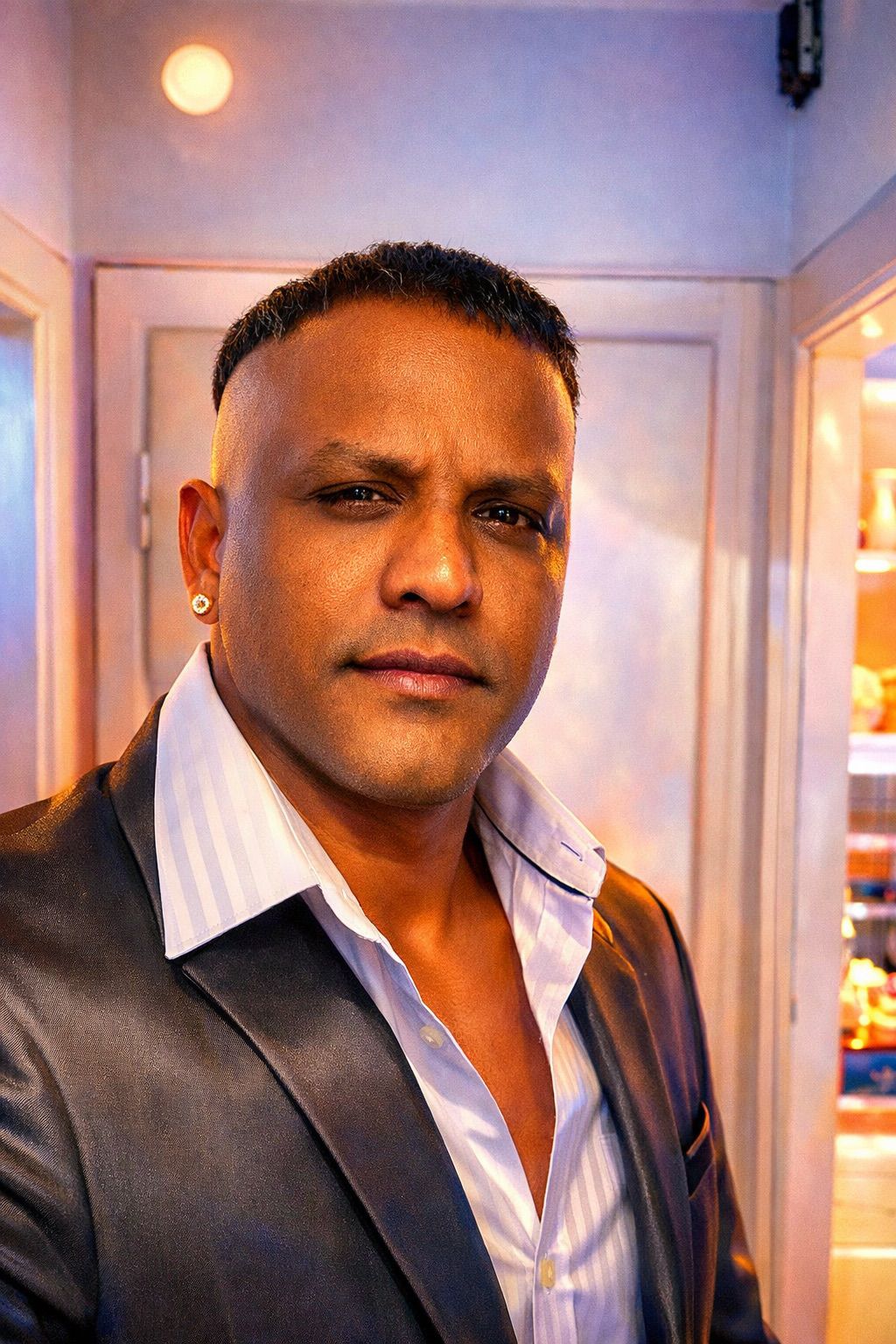
Today we’d like to introduce you to Senthil El Amador.
Hi Senthil, so excited to have you on the platform. So before we get into questions about your work-life, maybe you can bring our readers up to speed on your story and how you got to where you are today?
I come from Chidambaram, a temple town in Tamil Nadu in southern India. My beginnings were fairly ordinary. I went to local schools, played a lot of sports — kabaddi, basketball and cricket — and represented my school and later my polytechnic. I also enjoyed singing and oratory competitions. I was probably interested in too many things even then.
Books had an enormous influence on me. I wanted to improve my English, so I read constantly — Sidney Sheldon, John Grisham, V. S. Naipaul and whatever else I could get my hands on. Without really realizing it at the time, reading was teaching me language, but also introducing me to worlds far beyond the small town where I grew up.
I was writing too. I wrote poems from childhood and occasional short stories, and one of my poems won a prize in the United States when I was a teenager. I was equally fascinated by science and history. Looking back, I think that combination of technology and storytelling was already there; I just didn’t know where it would take me.
Eventually it took me out of India. I pursued my master’s degree in engineering at Nanyang Technological University in Singapore, where my academic work included digital signal processing and an IEEE conference paper. From there I moved into technology consulting, initially around Southeast Asia and later across Australia, Europe and the United States.
One thing that has remained constant throughout that journey is curiosity. I am always interested in territories I don’t fully understand yet. That curiosity eventually took me into healthcare and, particularly, medical imaging.
What struck me was the enormous expertise required to interpret medical images — and how unevenly that expertise is distributed. In major medical centers, specialist radiologists may be readily available. In smaller or underserved communities, that isn’t necessarily the case. When imaging is part of a critical or trauma pathway, delays in interpretation can also become delays in decision-making.
I started wondering whether AI could help narrow that gap — not by pretending to replace qualified physicians, but by providing useful preliminary decision support and helping medical professionals, researchers and students work with imaging more efficiently. That question eventually became ScanGuru.AI.
ScanGuru has grown into an AI medical-imaging platform covering multiple imaging modalities, with reporting designed for different audiences and multilingual use. An important part of the idea is accessibility. Universities can use ScanGuru free for non-commercial academic purposes, and my longer-term hope is that the technology can also be useful to charitable hospitals and underserved healthcare environments.
Building ScanGuru then led me to another question. As organizations adopt more and more AI models, how do they decide which intelligence should perform a task, under what policy, at what cost and risk, and when a human should remain in the loop? That became EQAL, another project I am currently developing around enterprise AI orchestration and governance.
This fall, I will also attend an executive program at Wharton focused on AI and digital transformation. I see that less as a destination and more as another opportunity to challenge what I think I know and learn from people approaching these problems from very different perspectives.
And through all of this, the child who wrote poems never entirely disappeared. I still write and create stories. Under my Amador creative slate, I am developing several original film and animation projects, including Doosra, The Last Koi, The Pearl and the Eunuch and Tatanka. Several of these projects are now being developed and submitted for international film and animation markets, including the Asia TV Forum & Market (ATF) in Singapore, with the long-term ambition of seeing these stories find a home with global platforms and studios such as Netflix, HBO or other major international producers. Whether that happens remains to be seen – but I believe there is something worthwhile in taking an improbable idea seriously enough to give it a chance.
People sometimes see technology, healthcare and storytelling as completely different worlds. I don’t really see them that way. The common thread for me has always been curiosity — finding something I don’t understand, asking “Why?” or “Why doesn’t this exist?”, and then seeing how far I can go trying to understand it or build it.
So I suppose the journey from Chidambaram to where I am today wasn’t really planned. One curiosity simply led to another.
We all face challenges, but looking back would you describe it as a relatively smooth road?
It hasn’t always been a smooth road, although I have never been very comfortable telling stories about my own struggles. I think adversity is relative, and many people have faced circumstances far more difficult than mine.
I was bullied at times as a child and experienced my share of rejection, but I was also fortunate to grow up playing competitive sports — kabaddi, basketball and cricket. Sport taught me something that has stayed with me throughout my life: you can lose the game without losing the lesson. It taught me to compete, bounce back and, equally importantly, remain humble when things go your way.
One experience at Nanyang Technological University in Singapore has stayed particularly vivid in my memory.
While completing my engineering master’s, I was selected for an industry research opportunity with a major company. The company would provide a monthly stipend while I conducted my engineering research with them, with the resulting intellectual property shared with the university.
I thought it was an extraordinary opportunity. To my surprise, my department initially saw it very differently.
My Head of Department opposed the arrangement, and I was essentially told that if earning money was important to me, I should leave university and go to work rather than pursue the research position. Even among some fellow students, there was resentment because I had been selected for a paid research opportunity while many students were earning extra money through tutoring.
I could have simply accepted the decision, but something about it didn’t seem right. So I kept asking questions and eventually took the matter to the university’s intellectual-property leadership. After reviewing the arrangement, they supported my position and gave me the clearance to continue.
I completed my studies and the research eventually resulted in an IEEE conference paper presented in Japan. There was a little irony in the ending: the professor who had initially followed the department’s opposition ultimately became a co-author of the paper. 😄
I don’t tell that story because I think I “defeated” anyone. What stayed with me was something different: sometimes rejection is information, and sometimes rejection is simply a decision that deserves to be questioned. You have to learn the difference.
Years later, I find myself learning that lesson again with ScanGuru.AI.
Building the technology turned out to be only part of the challenge. For ScanGuru to become meaningful, it needs engagement, feedback and validation from medical and academic institutions. Initially I approached that in the way a technology person naturally might — email campaigns, online demonstrations, outreach and even looking at hiring people to represent the product.
Progress was slower than I wanted.
Eventually I realized that I was asking other people to open doors for something that was ultimately my responsibility. So I put myself on the road. I became ScanGuru’s first sales representative. 😄 I started visiting universities myself, carrying the product into meetings, demonstrating it directly to doctors and listening to what they liked — and, more importantly, what they didn’t.
That changed things. It also reminded me that there is a big difference between believing in something from behind a computer screen and being willing to stand in front of another person and ask them to believe in it too.
There is a saying that if you don’t work for your own dreams, eventually someone will hire you to work for theirs. I have spent much of my professional life helping organizations build ambitious things, and I am grateful for everything that experience taught me. But at some point I also wanted to take the risk of building some of my own.
So perhaps adversity doesn’t discourage me as much as it used to. Sometimes it gives me wings.
I still lose. I still get rejected. Emails still go unanswered, ideas still fail and there are plenty of things I have not figured out. But sport taught me very early that losing is part of competing.
You can lose the game. Just don’t lose the lesson.
Great, so let’s talk business. Can you tell our readers more about what you do and what you think sets you apart from others?
One principle behind ScanGuru.AI is very simple: healthcare and the benefits of technology should not belong only to the rich or the fortunate. They should be accessible to everyone.
That belief is behind our philosophy, “Heal for All.” It influenced decisions such as multilingual reporting and offering universities free access for non-commercial academic use. My hope is that, as ScanGuru develops, the same technology can also become useful to charitable hospitals and underserved communities where access to specialist expertise may be limited.
Interestingly, this idea did not begin with ScanGuru. In 2021, I released a music album called Heavens. It explored a very different subject — humanity, culture and religion — but the underlying thought was remarkably similar. We create boundaries around ourselves through nationality, language, wealth, culture and belief, while much of what makes us human is shared.
Years later, I realized that “Heal for All” is really another expression of the same philosophy. Where Heavens tried to look beyond boundaries through music, ScanGuru is trying to cross some of those boundaries through healthcare and technology.
I like creating things that can reach people beyond the boundaries they were created in.
What do you like best about our city? What do you like least?
I should probably confess that I am not a Maryland local, so I would be pretending if I gave you a list of favorite neighborhoods or restaurants. My connection to the United States has largely been through my professional work and my company, while I have lived and worked internationally.
What I do find particularly interesting about Maryland is the concentration of healthcare, medical research and academic institutions in the region. Given what I am building with ScanGuru.AI, that naturally gets my attention.
As for what I like least, I probably haven’t earned the right to complain yet. Ask me again after I’ve spent more time there! 😄
Pricing:
- Universities & academic institutions – Free
- Small clinics: Free tier — up to 100 scans per month
- Growing practices: From US$99/month
- Charitable healthcare initiatives: – Freemium
- Enterprise / institutional deployments: Custom pricing based on requirements
Contact Info:
- Website: https://scanguru.ai/
- LinkedIn: https://www.linkedin.com/in/senthilkumar007/
- Youtube: https://www.youtube.com/channel/UCIQZXl3FVbPCzfrcaVxpPkg